Although cut-out animation is not typically used for feature films, the style is often replicated using digital mediums. South Park is a popular contemporary example of cut-out animation style imitated using the computer. Adobe Flash is an animation program that is ideal for creating the cut-out animated look digitally.Cut Out Animation
Although cut-out animation is not typically used for feature films, the style is often replicated using digital mediums. South Park is a popular contemporary example of cut-out animation style imitated using the computer. Adobe Flash is an animation program that is ideal for creating the cut-out animated look digitally.Stop Motion/Claymation
While traditional cell and computer 3D animation are the most widely used forms of animation, many feature films used puppet animation in their films. One of the most famous and historic of these films, was King Kong which used a puppet for King Kong in many scenes. One of these scenes is included here.
The puppet was created using a metal armature as it's base. The armature provided a strong skeleton so that the puppets limbs could move more realistically. Over the armature, the fabrics and fur for King Kong's final look were applied. Once the puppet was ready to be filmed, it obviously could not act along with the human actors in the film. Therefore, the live-action and stop motion segments of the film were created separately, and then re-built togetherHenry Selick's Nightmare Before Christmas, used similar techniques for creating the stop motion puppets, however there was absolutely no live action within this film. Each character and set was built by hand and every image was filmed frame by frame.
Claymation is another very popular way to use stop motion. Similarly to puppet animation, at the base of the clay is an armature, or "skeleton." With clay, typically the armature is not made out of stiff metal, but out of steel wire. The wire allows for much more freedom and flexibility when manipulating the model. The clay is molded on top of this wire armature, and because clay is naturally very flexible, one can manipulate the model with relative ease.
One of the most popular figures in the world of claymation is Nick Park, who is perhaps most well known for his Wallace and Gromit characters. These Oscar-winning shorts feature Park's unmistakeable style, which he also used in his feature film, Chicken Run. Though Chicken Run is not Park's most well-known film, it is very important because it was the first stop motion film in Europe to use the "Digital Intermediate" process. Within this process, the film is converted to digital bits, and then converted back to film. The result is high resolution, processed, color-corrected image.All of these forms of stopmotion animation have proven useful in creating new looks for animation, or for combining live action and puppetry in order to give the illusion that the impossible is possible. Enjoy this behind-the-scenes look at
Wallace and Gromit - A Matter of Loaf and Death.
Pixilation
Why use still images when people can move as directed? One of the most prevalent uses of pixilation is to give the illusion that a body is doing something physically impossible. For example, in this video, it appears as though the boy is floating.
A variety of other illusions can be accomplished using pixilation. One of the most famous and acclaimed shorts which employed these technique's is Norman McClaren's Neighbors.
Pinscreen Animation

The pin screen is a white screen embedded with thousands of headless pins, and is used for two dimensional animation. In order to create images, as seen on the right, the animator pushes certain pins all the way into the screen while pulling other pins all the way out. When a white light is shone crom the side of the screen, the pins sticking out create dark shadows, the pins all the way in create highlights, and the pins in the midde create varying gray tones.
Alexander Alexeiff and his wife Claire Parker designed the pinscreen in 1931 with the intention of creating a new technique for animation. After designing and building the screen, they filmed the first animation using a pinscreen called, A Night on Bald Mountain, presented here.
As you can see, the effect of the pin screen (which is also combined with some live-action footage here) was very different from what could be acheived with traditional and stop motion animation. In the following video, Alexander Alexeiff and Clair Parker demonstrate how they used the screen to create their pin images.
While the pin screen was never a widely used technique, it offered alternatives to traditional animation techniques of the time.
Rotoscoping
Definition
Rotoscoping is an animation technique in which animators trace over live-action film movement, frame by frame, for use in animated films.[1] Originally, pre-recorded live-action film images were projected onto a frosted glass panel and re-drawn by an animator. This projection equipment is called a rotoscope, although this device has been replaced by computers in recent years. In the visual effects industry, the term rotoscoping refers to the technique of manually creating a matte for an element on a live-action plate so it may be composited over another background.
Techniques
Rotoscoping (often abbreviated as "roto") has often been used as a tool for visual effects in live-action movies. By tracing an object, a silhouette (called a matte) is created that can be used to extract that object from a scene for use on a different background. While blue and green screen techniques have made the process of layering subjects in scenes easier, rotoscoping still plays a large role in the production of visual effects imagery. Rotoscoping in the digital domain is often aided by motion tracking and onion-skinning software. Rotoscoping is often used in the preparation of garbage mattes for other matte-pulling processes.
Animal Rotoscope Motion Studies from Evan Boucher on Vimeo.
Experimental Animation
• Drawn on film animation: a technique where footage is produced by creating the images directly on film stock, for example by Norman McLaren, Len Lye and Stan Brakhage.
Caroline Leaf's Two Sisters (1991), an award-winning short which uses drawn-on-film animation --- http://www.youtube.com/watch?v=ITlfQ03hXbM
• Paint-on-glass animation: a technique for making animated films by manipulating slow drying oil paints on sheets of glass.
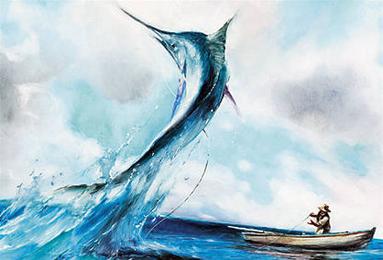
Aleksandr Petrov's 1999 The Old Man and the Sea (Academy Award for Animated Short Film) --- http://www.youtube.com/watch?v=v1EbNvHDxbA
• Erasure animation: a technique using tradition 2D medium, photographed over time as the artist manipulates the image. For example, William Kentridge is famous for his charcoal erasure films.
• Sand animation: sand is moved around on a backlighted or frontlighted piece of glass to create each frame for an animated film. This creates an interesting effect when animated because of the light contrast.
• Flip book: A flip book (sometimes, especially in British English, called a flick book) is a book with a series of pictures that vary gradually from one page to the next, so that when the pages are turned rapidly, the pictures appear to animate by simulating motion or some other change. Flip books are often illustrated books for children, but may also be geared towards adults and employ a series of photographs rather than drawings. Flip books are not always separate books, but may appear as an added feature in ordinary books or magazines, often in the page corners. Software packages and websites are also available that convert digital video files into custom-made flip books.